

On November 10, 2026, the Securities and Exchange Commission announced its enforcement results for fiscal year 2026, which ended September 30, 2026.[1] The Commission filed 348 enforcement actions, including 235 standalone actions, 47 “follow-on” administrative proceedings – which bar or suspend individuals from the securities industry based on criminal convictions, civil injunctions or other qualifying orders – and 66 actions against delinquent filers, and obtained orders for $1.095 billion in monetary relief. By any measure, the numbers are low, and the total is the smallest annual figure the SEC has reported since at least fiscal year 2018.
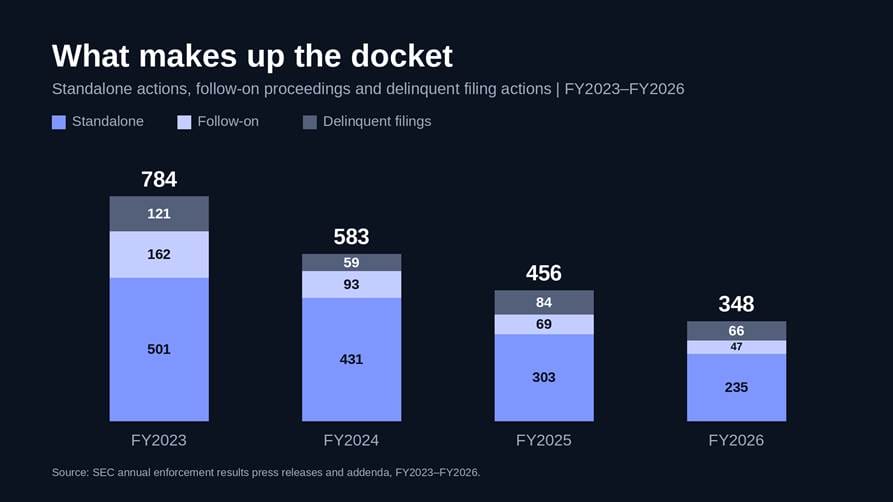
But fewer cases do not mean less risk, and the SEC maintains that it is still concentrating on fraud, insider trading and gatekeeper misconduct, as well as on disclosures related to artificial intelligence, as reported in Bracewell’s recent client alert. Although the numbers may tell a different story, SEC Chairman Paul S. Atkins stated that enforcement actions and financial remedies “are important measures of activity, but they are not the only or most telling measures.” Enforcement Director David Woodcock described an enforcement program that is “more focused, effective and prepared to address both longstanding and emerging threats to our markets.”
By the Numbers: A Third Straight Year of Decline
Total enforcement actions have fallen each year since fiscal year 2023 when the SEC filed 784 actions. The Commission filed 583 actions in fiscal year 2024 (a 26 percent decline), 456 in fiscal year 2025 (a 22 percent decline) and 348 in fiscal year 2026 (a 24 percent decline).[2] Measured from fiscal year 2023, the SEC’s annual enforcement output has dropped by more than half.[3]
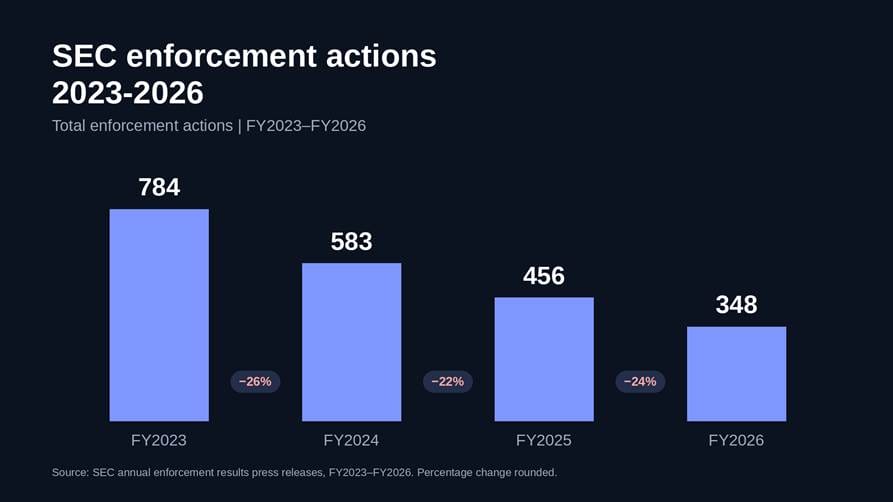
The pace of enforcement tells the same story. In fiscal year 2026, the SEC filed an average of roughly 29 enforcement actions per month, compared with roughly 38 per month in fiscal year 2025, 49 in fiscal year 2024 and 65 in fiscal year 2023. Standalone actions, one gauge of new enforcement activity, averaged fewer than 20 per month in fiscal year 2026, compared with roughly 25 in fiscal year 2025 and 36 in fiscal year 2024.
| Metric | FY2023 | FY2024 | FY2025 | FY2026 |
| Total enforcement actions | 784 | 583 | 456 | 348 |
| Standalone actions | 501 | 431 | 303 | 235 |
| Follow-on proceedings | 162 | 93 | 69 | 47 |
| Delinquent filing actions | 121 | 59 | 84 | 66 |
| Total monetary relief ordered | $4.949 billion | $8.2 billion | $17.9 billion ($2.7 billion as adjusted by the SEC[4]) | $1.095 billion |
| Disgorgement and prejudgment interest ordered | $3.369 billion | $6.1 billion | $10.8 billion ($1.4 billion as adjusted) | $752 million |
| Civil penalties ordered | $1.580 billion | $2.1 billion | $7.2 billion ($1.3 billion as adjusted) | $343 million |
| Returned to harmed investors | $930 million | $345 million | ~$262 million | ~$731 million |
| Whistleblower awards | ~$600 million | $255 million | ~$60 million (48 individuals) | >$158 million (65 individuals) |
Inside the Docket: A Broad-Based Decline
Enforcement results have declined across every category of action. Standalone actions fell 22 percent year-over-year and are down 53 percent from fiscal year 2023. Follow-on proceedings fell 32 percent, from 69 in fiscal year 2025 to 47 in fiscal year 2026 and are down 71 percent from fiscal year 2023. Delinquent filing actions fell 21 percent, from 84 to 66. As a result, the mix of the SEC’s enforcement docket has held relatively steady, as standalone actions made up roughly two-thirds of all actions in both fiscal years 2025 and 2026.[5]
Individual accountability remains a central theme. Two-thirds of the SEC’s standalone actions in fiscal year 2026 charged at least one individual, the same proportion the SEC reported for fiscal year 2025. In April 2026, the Commission reported that “nearly nine out of every 10” standalone actions filed under Acting Chairman Mark T. Uyeda and Chairman Atkins involved individual charges.[6] The fiscal year 2026 figure, which reflects the first full fiscal year under Chairman Atkins, is lower than the nine-in-ten rate. The SEC does not explain the difference, which may reflect a docket that still includes a meaningful number of entity-only settlements, such as the compliance-focused orders.
Monetary Remedies Reset
The swing in monetary relief over the past three years has been dramatic. In fiscal year 2024, the SEC touted $8.2 billion in financial remedies, “the highest amount in SEC history,” roughly 56 percent of which was attributable to a single judgment against Terraform Labs and Do Kwon.[7] In fiscal year 2025, the SEC reported a headline figure of $17.9 billion, but the SEC itself calculated that, after excluding “deemed satisfied” amounts and judgments, the total was $1.4 billion in disgorgement and prejudgment interest and $1.3 billion in civil penalties. In fiscal year 2026, the SEC obtained orders for $752 million in disgorgement and prejudgment interest and $343 million in civil penalties.
The steepest decline is in civil penalties. The $343 million in penalties ordered in fiscal year 2026 is roughly 74 percent below fiscal year 2025’s adjusted figure and 84 percent below fiscal year 2024’s $2.1 billion. Part of that difference reflects the end of the Commission’s off-channel communications initiative, in which the SEC brought a slew of recordkeeping charges against firms that failed to preserve records kept on employee’s personal devices or unapproved messaging platforms. In fiscal year 2024 alone, recordkeeping cases produced more than $600 million in penalties against more than 70 firms.[8] The current Commission has sought to distance itself from those matters, describing the 95 off-channel actions and $2.3 billion in penalties since fiscal year 2022 as cases that “identified no direct investor harm” and reflected “a misallocation of Commission resources.”[9]
Whistleblower activity also rebounded. The SEC awarded more than $158 million to 65 individual whistleblowers in fiscal year 2026, up from approximately $60 million to 48 individuals in fiscal year 2025.
Shifting Priorities
A side-by-side reading of the last three annual releases shows a clear evolution in the SEC’s enforcement priorities.
Fiscal year 2024: Volume and sweeps. Under Chair Gary Gensler, the SEC highlighted “proactive initiatives addressing widespread noncompliance,” including the off-channel communications sweep, settling Marketing Rule charges against more than a dozen investment advisers and taking on a series of whistleblower protection cases. The Division of Enforcement also emphasized emerging technology cases involving artificial intelligence, cybersecurity disclosures and crypto assets.
Fiscal year 2025: Realignment. The current Commission described its first year as a period in which it “put a stop to regulation by enforcement.” Beginning in February 2025, the SEC dismissed seven crypto enforcement actions brought by the prior Commission, including its cases against Coinbase and Binance. It also launched the Cyber and Emerging Technologies Unit in February 2025 and the Cross-Border Task Force in September 2025, while concentrating resources on offering frauds, market manipulation, insider trading and individual accountability.[10]
Fiscal year 2026: Institutionalizing the new priorities. This year, the Division built formal structures around its latest priorities, including the Financial Reporting and Accounting Unit (FRAU), described in Bracewell’s prior alert. The unit pairs attorneys with accountants to pursue accounting and financial reporting fraud, as well as misconduct by accountants and auditors. Also new is the Retail Fraud Working Group (RFWG), which targets Ponzi schemes, offering frauds, impersonation scams and similar misconduct affecting everyday investors that has already generated more than a dozen new investigations. Additionally, as mentioned above, the Division is poised to bring new actions against firms whose AI disclosures fall short, including by accurately describing their AI investments.
Where the Trend Is Heading
Several signals suggest that the decline in case counts may be nearing its floor, even if the SEC does not return to the volumes of fiscal years 2023 and 2024.
- The current Commission has said that fraud cases “inherently require more time and resources to develop and bring, often requiring up to two or more years to manifest results.”[11] The new RFWG and FRAU, together with targeted hiring of attorneys, accountants, technologists and data specialists, are designed to feed that pipeline. A new performance-management process, with bi-monthly meetings between senior officers and Division leadership on investigative timelines and milestones, suggests investigations may move faster once opened.
- As Bracewell noted earlier this year, data from the US Government Accountability Office indicated that the Enforcement Division lost 18 percent of its staff after the new administration took office. The Division’s targeted hiring is aimed at reversing that trend, but capacity will continue to limit volume in the near term.
- The SEC’s investment in “Super Intelligence” anomaly detection and blockchain and financial-flow analysis, through a new Office of Super Intelligence and Analytics, means more cases are likely to begin with the SEC’s own data rather than with a tip or a self-report.
Practical Implications
- Lower volume does not mean lower risk. The cases the SEC is bringing are concentrated in fraud, manipulation, insider trading and financial reporting, and they are more likely to involve parallel criminal exposure.
- Individuals remain squarely in the crosshairs. With two-thirds of standalone actions naming at least one individual, executives, finance personnel, auditors and investment professionals should consider separate counsel early, and companies should revisit indemnification, advancement and D&O insurance arrangements before an investigation begins.
Bracewell’s government enforcement and investigations team has extensive experience representing companies, boards and individuals in SEC investigations, parallel criminal matters and enforcement litigation. If you have questions about how these developments may affect your organization, please contact the authors or your Bracewell relationship lawyer.
Elya Nassaj is a co-author of this article.
[1] Press Release, U.S. Sec. & Exch. Comm’n, SEC Announces Enforcement Annual Results for Fiscal Year 2026, No. 2026-113 (Nov. 10, 2026). Unless otherwise noted, all fiscal year 2026 figures and quotations are drawn from this release and its addendum. Percentage changes and per-month averages throughout this alert are our calculations from the SEC’s reported figures and are rounded.
[2] Press Release, U.S. Sec. & Exch. Comm’n, SEC Announces Enforcement Results for Fiscal Year 2023, No. 2023-234 (Nov. 14, 2023); Press Release, U.S. Sec. & Exch. Comm’n, SEC Announces Enforcement Results for Fiscal Year 2024, No. 2024-186 (Nov. 22, 2024) [hereinafter FY2024 Release]; Press Release, U.S. Sec. & Exch. Comm’n, SEC Announces Enforcement Results for Fiscal Year 2025, No. 2026-34 (Apr. 7, 2026) [hereinafter FY2025 Release].
[3] Fiscal year 2025 may serve as an imperfect baseline as the SEC attributes part of that year’s volume to a pre-inauguration “rush” of filings. FY2025 Release, supra note 2. In fiscal year 2026, $235 million of disgorgement was deemed satisfied by orders in non-SEC actions; net of that amount, relief totaled $860 million. U.S. Sec. & Exch. Comm’n, Div. of Enf’t, Addendum to Division of Enforcement Press Release: Fiscal Year 2026, at 1 (2026) [hereinafter FY2026 Addendum].
[4] As adjusted by the SEC to exclude disgorgement “deemed satisfied” by orders in separate non-SEC actions and judgments. FY2025 Release, supra note 2. The adjusted total also excludes $71 million in off-channel recordkeeping penalties ordered in early fiscal year 2025. U.S. Sec. & Exch. Comm’n, Div. of Enf’t, Addendum to Division of Enforcement Press Release: Fiscal Year 2025, at 1 nn.2, 4 (2026) [hereinafter FY2025 Addendum]. The fiscal year 2026 adjusted figure excludes $235 million deemed satisfied. FY2026 Addendum, supra note 3, at 1.
[5] FY2026 Addendum, supra note 3, at 1; FY2025 Addendum, supra note 4, at 1; U.S. Sec. & Exch. Comm’n, Div. of Enf’t, Addendum to Division of Enforcement Press Release: Fiscal Year 2024, at 2 (2024).
[6] FY2025 Release, supra note 2 (reporting that approximately two-thirds of standalone actions in fiscal year 2025 involved charges against one or more individuals, a 27% year-over-year increase).
[7] FY2024 Release, supra note 2.
[8] Id.
[9] FY2025 Release, supra note 2.
[10] Id.
[11] Id.