

What to Know
- CFTC policy incentivizes self-reporting and cooperation with potential enforcement declinations.
- Companies can earn major penalty reductions through remediation, cooperation, and restitution efforts.
- Clear standards increase compliance focus on internal controls, audits, and timely misconduct reporting.
On May 19, 2026, the Commodity Futures Trading Commission’s Division of Enforcement (the Division) announced its new policy for crediting self-reporting and cooperation in settlement recommendations to the Commission.[1] The new policy meaningfully incentivizes voluntary self-reporting and cooperation by delineating clear and specific standards to qualify for either the complete avoidance of an enforcement action or substantially reduced monetary penalties. The new policy supersedes and rescinds all previous Division policies on cooperation. The substantial potential benefits the policy offers warrant reviewing whether internal trading controls, compliance processes, and audit and self-reporting policies align with the policy’s prerequisites.
Notwithstanding the substantial improvements of the new policy, like its predecessors, it does not provide guidelines for the actual dollar amount of penalties that would apply to specific types of violations in the absence of self-reporting and cooperation. Rather, percentage reductions of penalties will be recommended only against what the policy describes as the Division’s “good-faith calculated penalty.” The new policy consequently does not eliminate the possibility that a settling party could perceive its cooperation as unrewarded in the event the Division’s “good-faith calculated penalty” seems excessive to begin with.
The Prerequisites for Enforcement Declinations
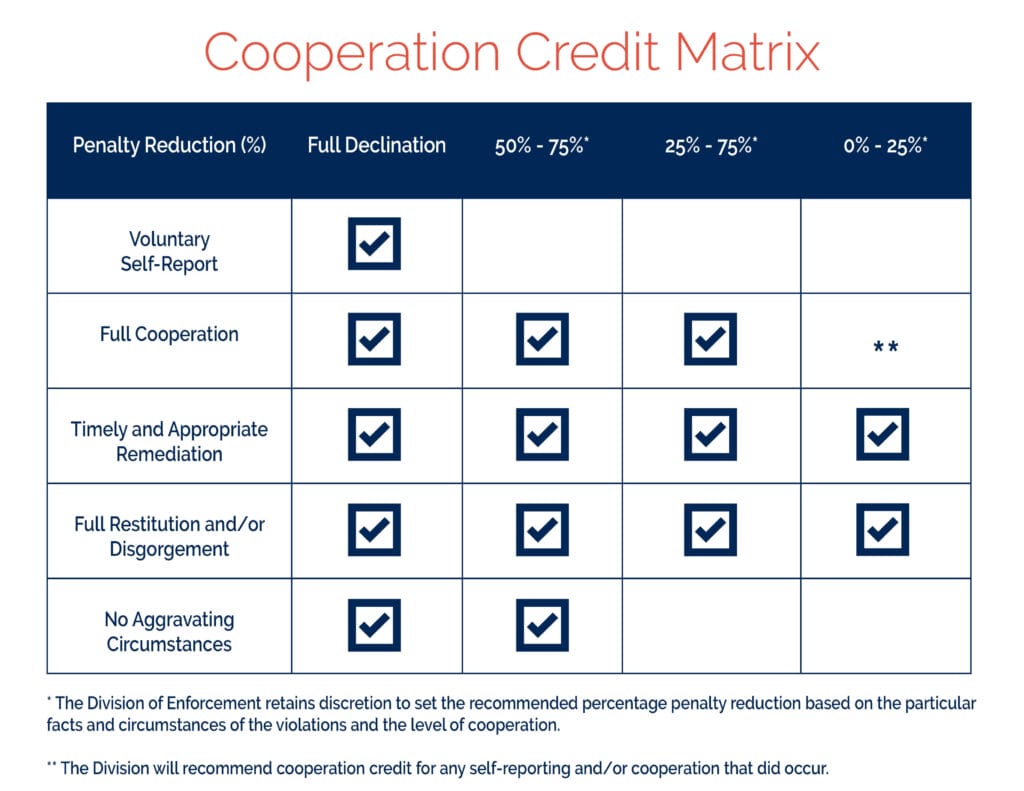
The most significant development in the new policy is its articulation of a clear, five-part test to qualify for a formal declination — which is a decision by the Division not to recommend an enforcement action against a company or individual.[2] Under the new policy, the Division will issue a declination when all of the following elements are met.
- The party made a Voluntary Self-Report to the CFTC
- The party provided Full Cooperation during the Division’s investigation
- The party effected Timely and Appropriate Remediation of the misconduct
- The party provided Full Restitution and/or Disgorgement, if applicable
- There are no aggravating circumstances
The policy specifically defines the four key prerequisite actions Voluntary Self-Report, Full Cooperation, Timely and Appropriate Remediation, and Full Restitution and/or Disgorgement.
Voluntary Self-Report. The Division will make a careful assessment of the circumstances surrounding any self-report, including the extent to which the report enabled the Division to “preserve and obtain relevant evidence”.[3] Among the requirements: the report must be made in good faith, with the Division considering the circumstances leading to the report, its timing and completeness, and the level of transparency provided. The report must be made voluntarily — meaning it must occur before any known or reasonably anticipated imminent threat of disclosure through a whistleblower, the media, or other channels, or before any known or reasonably anticipated imminent threat of an investigation. The party must also disclose misconduct within a reasonably prompt time after becoming aware of it, and the Division expects Market Participants to report at the earliest possible opportunity and not defer disclosure until a routine or periodic reporting date.
A voluntary, good faith self-report that otherwise satisfies the requirements will qualify as a Voluntary Self-Report even if the CFTC already has independent knowledge of the misconduct. Importantly, the Division provides a safe harbor that inaccuracies in a self-report will not be charged as Commodity Exchange Act violations if the self-report was made in good faith and if any inaccurate information is supplemented and corrected promptly after discovery of its inaccuracy.
Full Cooperation. Full Cooperation requires (1) timely disclosure of all non-privileged, relevant information concerning the misconduct, including information gathered during any internal investigation, and (2) identification of all individuals involved in or responsible for the misconduct. The disclosure must provide attribution of information to specific sources when doing so will not violate any privilege. Cooperation must also be “proactive,” including disclosure of relevant information even when not specifically requested, and identification of opportunities for the Division to obtain evidence not in the party’s possession or otherwise unknown to the Division.
Full Cooperation also requires production of overseas documents and identification of the location where they are found, their custodians, and the individuals who authored them and located them. Where foreign law would prohibit production, the party bears the burden of establishing the prohibition and, if possible, must identify reasonable, lawful alternatives to provide the Division with the necessary information. The party must coordinate the timing of its own internal investigative steps with the Division’s requests, including delaying interviews for limited periods when specifically requested. Full Cooperation requires, subject to individuals’ Fifth Amendment Rights, making current and former company personnel, including those located overseas, available for interviews, and facilitating interviews of relevant third parties when possible.
Timely and Appropriate Remediation. Remediation requires a thorough “root-cause analysis” of the misconduct and, where appropriate, implementation of measures designed to address those root causes.[4] It also requires the implementation of an effective compliance and ethics program, calibrated to the size and resources of the organization and the risks associated with its business. Specific remediation elements include appropriate discipline of employees responsible for the misconduct, including both those individuals who directly engaged in the wrongdoing and those who failed in their oversight responsibilities. Notably, the policy expressly requires implementation of appropriate “record-retention measures.” These include prohibiting the improper destruction or deletion of business records, and adequate controls over the use of personal devices and messaging applications. Such applications include “ephemeral messaging platforms” (presumably referencing applications like WhatsApp, Signal and Telegram) that could impair required record retention or compliance with legal obligations.
Full Restitution and/or Disgorgement. The Division must agree that the party has created and/or implemented an appropriate plan to provide full restitution to those harmed by any violations, and a party may satisfy this obligation by making full restitution even before reaching agreement with the Division.
Tiered Penalty Reductions Where a Declination Is Unavailable
As summarized in the table below, when a party has not met the terms for a full declination, the policy provides a tiered system of partial civil monetary penalty reductions. When a party is ineligible for a declination because it acted in good faith by self-reporting the misconduct but the self-report did not meet the requirements of a Voluntary Self-Report, it may still qualify for a 50 percent to 75 percent reduction from the Division’s “good-faith calculated penalty” if the party provided Full Cooperation, Timely and Appropriate Remediation, and Full Restitution and/or Disgorgement, and there are no aggravating circumstances. If a party meets all the criteria for a declination except the party’s self-report did not qualify as a Voluntary Self-Report and there are aggravating circumstances, the party may still qualify for a 25 percent to 75 percent penalty reduction.
For parties who do not qualify under either of the above tiers, the Division retains discretion to recommend cooperation credit for any self-reporting and/or cooperation that did occur, provided the party has engaged in Timely and Appropriate Remediation and provided Full Restitution and/or Disgorgement. In such cases the Division may recommend no more than a 25 percent reduction to the Division’s “good-faith calculated penalty” unless extraordinary circumstances would support a greater reduction.
Conclusion and Takeaways
The CFTC Division of Enforcement’s new policy provides substantial benefits, including the potential for a declination, for timely self-reporting, full cooperation, remediation, restitution and disgorgement. Timing can be critical to securing those benefits: the requirements for a Voluntary Self-Report are strict, and waiting for a whistleblower complaint or a regulatory inquiry to crystallize before self-reporting violations potentially could foreclose the most favorable outcome.
Facets of internal compliance controls and procedures that should be reviewed for alignment with the policy’s prerequisites include policies for (1) self-reporting, (2) internal compliance reviews and investigations, (3) internal audit, (4) employee disciplinary actions, (5) retention of communications over ephemeral messaging applications on personal communication devices, (6) remediation and restitution for wrongful acts, (7) training on prohibited conduct, and (8) training supervisors and compliance staff on the new Division policy so they will be prepared to take the actions necessary to secure its benefits, if and when that is desired.
Please reach out to the authors with any questions.
[1] CFTC Staff Issues Advisory on Cooperation in Enforcement Matters, Commodity Futures Trading Comm’n Press Release No. 9234-26 (May 19, 2026).
[2] CFTC Letter No. 26-15, New Division of Enforcement Policy on Cooperation (May 19, 2026). Specifically, this policy rescinds CFTC Enforcement Advisory, Advisory on Self-Reporting, Cooperation, and Remediation (Feb. 25, 2025). The Division’s Enforcement Manual will be updated to reflect this new policy.
[3] CFTC Letter No. 26-15 at 4.
[4] CFTC Letter No. 26-15 at 6.